📜 In This Article
- Legal Framework — What Law Governs Driving Schools?
- Who Needs a Driving School Licence?
- Eligibility — Who Can Apply?
- Infrastructure Requirements
- Instructor Qualifications
- Vehicles Required
- Documents Required
- Apply Online via Sarathi Parivahan
- Apply Offline at the RTO
- RTO Inspection Process
- Prescribed Training Curriculum
- Fees for Driving School Licence
- Renewal and Ongoing Compliance
- Frequently Asked Questions
Legal Framework — What Law Governs Driving Schools?
Driving schools in India are regulated by a specific set of laws and rules. Understanding the legal foundation is important before starting the application process.
Motor Vehicles Act, 1988 — Section 12
Section 12 is the primary law that authorises the central government to make rules for licensing and regulating driving schools and establishments. It specifies what the rules may cover — application procedure, licence conditions, instructor qualifications, inspection, records, financial stability, driving certificates, and curriculum.
Central Motor Vehicles Rules, 1989 — Rule 24
Rule 24 specifies the operational requirements for driving schools. It states that no person shall establish or maintain any driving school for imparting driving instruction for hire or reward without a licence in Form 11 granted by the licensing authority (typically the Regional Transport Officer).
State Motor Vehicles Rules
Each state also has its own Motor Vehicles Rules that supplement the central rules. These govern state-specific requirements such as the exact land area, fee amounts, local language requirements for instructors, and the RTO's inspection process. Always verify your specific state's requirements with the local RTO.
Who Needs a Driving School Licence?
Under Rule 24 of CMVR 1989, any person or entity that imparts instruction in driving motor vehicles for hire or reward must hold a valid driving school licence. This means:
- Commercial driving academies and institutes that charge a fee for driving lessons
- Motor driving schools offering training for LMV, MCWG, or heavy/transport vehicle categories
- Schools or establishments that issue driving certificates to transport vehicle applicants
- Fleet operators running in-house driver training programmes where trainees are charged or it is part of a commercial operation
Who Does NOT Need a Driving School Licence
- A parent teaching their own child to drive (not for hire or reward)
- A friend teaching another person informally on private property (not for hire or reward)
- Corporate in-house driver safety programmes (not charging a separate tuition fee — check with your state RTO)
Eligibility — Who Can Apply for a Driving School Licence?
For the Applicant / School Owner
- Age: Must be at least 21 years old (varies by state — some require 25)
- Nationality: Indian citizen, or a valid registered entity (company, trust, society, or partnership firm)
- No disqualification: Must not be disqualified from holding or obtaining a driving licence or any transport-related permit
- No criminal conviction related to road transport offences
- Financial stability: The school must demonstrate adequate financial resources to maintain premises, vehicles, and staff (specific proof may be required — bank statements or solvency certificates)
For a Company / Institution Applicant
- Valid Certificate of Incorporation (for companies) or registration certificate (for trusts, societies)
- GST registration (if applicable under the school's turnover)
- A designated responsible person / principal officer whose name appears on the licence
Infrastructure Requirements for a Driving School
This is the most critical part of the application — the RTO will physically inspect your premises before granting the licence. Requirements are set by each state's rules, but the general minimum standards under CMVR are:
Driving Practice Area / Track
A dedicated driving practice area where learners can practise basic vehicle control, manoeuvring, and parking. For LMV schools, a minimum plot of approximately 1,000 sq. metres is commonly required for the practice track. Schools offering heavy vehicle training need substantially more space. The track must include space for an 8-figure course (for two-wheelers), gradient practice, and parking manoeuvres.
Classroom / Training Room
A dedicated classroom with adequate seating, ventilation, and lighting for theory classes. The classroom must be equipped for teaching traffic signs, road rules, and vehicle mechanics. A blackboard, projector, or display system for visual aids is recommended. Minimum area typically 200–300 sq. ft depending on state rules.
Display Materials
Charts of traffic signs and signals, road markings diagrams, first aid procedures, and the prescribed curriculum must be displayed in the classroom. These are verified during RTO inspection.
Office and Records Room
A dedicated office/administrative area for maintaining mandatory records — student registers, instructor attendance, vehicle maintenance logs, and training completion certificates. Records must be preserved for a period specified by the state (typically 3–5 years).
Instructor Qualifications — CMVR Rule Requirements
Under the Central Motor Vehicles Rules, 1989, every instructor employed at a licensed driving school must meet specific qualifications. These are verified by the RTO during inspection.
Mandatory Qualifications for Every Instructor
- Valid permanent driving licence for the class of vehicle they will teach (LMV, MCWG, heavy vehicle etc.) — with at least 3–5 years of holding experience (state-specific)
- Thorough knowledge of traffic signs as specified in the Schedule to the Motor Vehicles Act and regulations under Section 118
- Ability to demonstrate and explain the functions of different vehicle components and driving controls to students
- Knowledge of English or the regional language of the state/region where the school operates — so they can teach and communicate effectively with students
- Knowledge of first aid and road safety — basic first aid training certificate is required in many states
- Minimum age: Typically 25 years old to be a qualified driving instructor
- No criminal record involving road transport offences, traffic violations, or other serious offences
Minimum Number of Instructors
Most states require a minimum of 1–2 qualified instructors per vehicle category offered at the school. A school offering both two-wheeler and four-wheeler training typically needs at least one qualified instructor for each category. Some states also require a designated Principal Instructor or Chief Driving Instructor (CDI) who oversees the programme.
Vehicles Required for a Licensed Driving School
The school must own or have registered in its name a minimum number of training vehicles. These must be roadworthy, properly registered, insured, and maintained with valid PUC certificates. RTO inspectors check all vehicles during the licence inspection.
| Training Category | Minimum Vehicles Required | Special Requirements |
|---|---|---|
| Two-wheelers (MCWG) | Minimum 1 motorcycle (geared) | Must be registered in school's name; valid insurance and PUC |
| Two-wheelers (MCWOG) | Minimum 1 scooter/moped (non-geared) | Separate vehicle for MCWOG training |
| Light Motor Vehicle (car) | Minimum 1–2 cars | Must have dual control (instructor brake pedal on passenger side) — mandatory for all LMV training vehicles |
| Heavy vehicles (HGV/bus) | Minimum 1 heavy vehicle | Much larger premises required; typically only specialised commercial schools |
Documents Required for Driving School Licence Application
- Application form (Form 11) — filled completely as per CMVR 1989
- Proof of premises ownership or registered lease deed — title deed (own land) or registered long-term lease agreement (minimum 10–15 years as per state rules)
- Site plan/layout — detailed plan of the driving school premises showing the practice track, classroom, office, parking, and dimensions
- RC (Registration Certificate) of all training vehicles — showing school as registered owner
- Valid insurance certificates for all training vehicles
- Valid PUC certificates for all training vehicles
- Dual control certificate/proof for LMV training vehicles — certificate from mechanic or manufacturer that dual controls are installed
- Instructor's driving licence copies — valid DL for each instructor employed, showing they hold the licence for the vehicles they teach
- Instructor's appointment letter / employment contract
- Identity proof of applicant — Aadhaar, Passport, PAN Card
- Address proof of applicant
- Proof of financial stability — bank statements (last 6 months) or solvency certificate
- Certificate of incorporation / registration — for companies, trusts, or societies applying for the licence
- NOC from local body / panchayat — if required by state rules
- Application fee payment receipt
Apply Online via Sarathi Parivahan Portal
The Sarathi Parivahan portal has a dedicated Driving School Licence module. The online application allows you to submit your application, upload documents, pay the fee, and track the status — all without multiple RTO visits for the initial application stage. The physical RTO inspection still happens after submission.
-
1Go to sarathi.parivahan.gov.in and select your state from the dropdown.
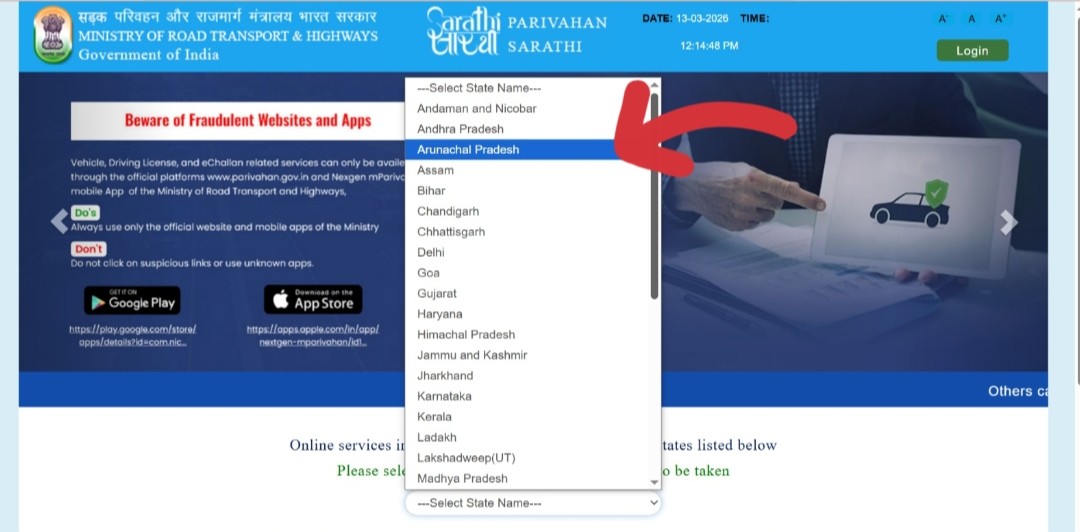 Visit sarathi.parivahan.gov.in and select your state
 -
2On the Sarathi dashboard, look for the "Driving School" section (may also appear under "Others" or "Driving School Licence" in the menu). Click "Apply for Driving School Licence."
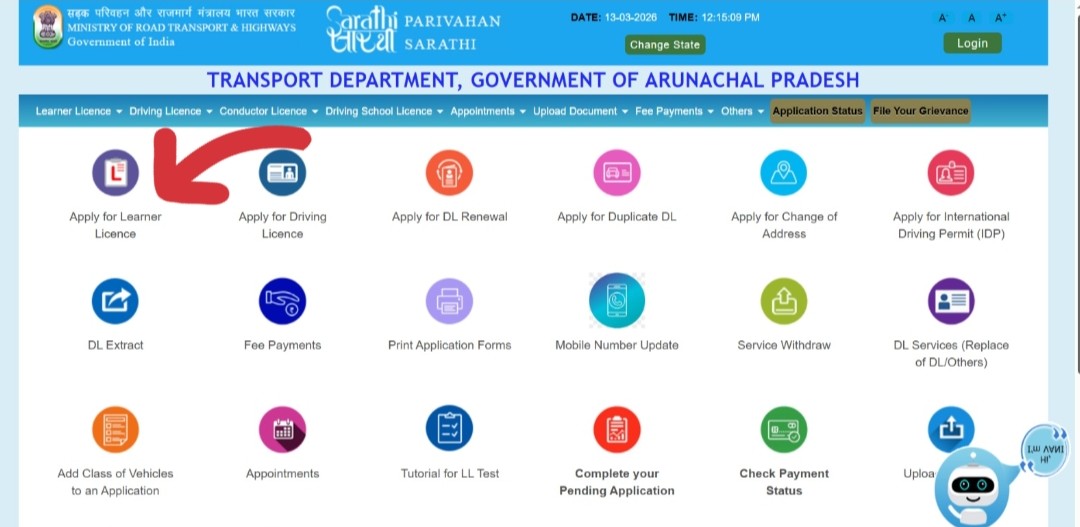 Navigate to the Driving School section and click Apply for Driving School Licence
 -
3Read the instructions carefully and click "Proceed." Enter your mobile number and verify via OTP to begin the application.
-
4Fill in Form 11 online with all required details:
- Name and personal details of the applicant / institution
- Name and proposed address of the driving school
- Type of vehicles for which training is proposed (LMV, MCWG, etc.)
- Details of instructors (name, DL number, experience)
- Details of training vehicles (registration number, make, model)
- Description of premises and facilities
-
5Upload all required documents — scanned copies in JPG or PDF format, under 500 KB each. See the full document list in Section 7.
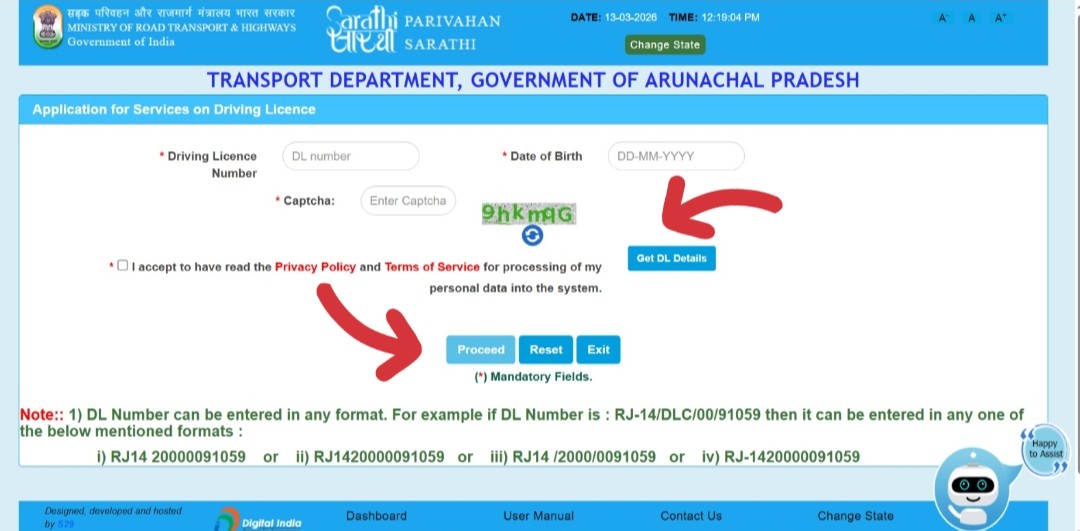 Fill Form 11 details and upload all required documents
 -
6Pay the application fee online via UPI, debit card, credit card, or net banking. Download and save the payment receipt.
-
7Submit the application. Download the acknowledgement slip with your application reference number. Use this to track the status and to communicate with the RTO about the scheduled inspection.
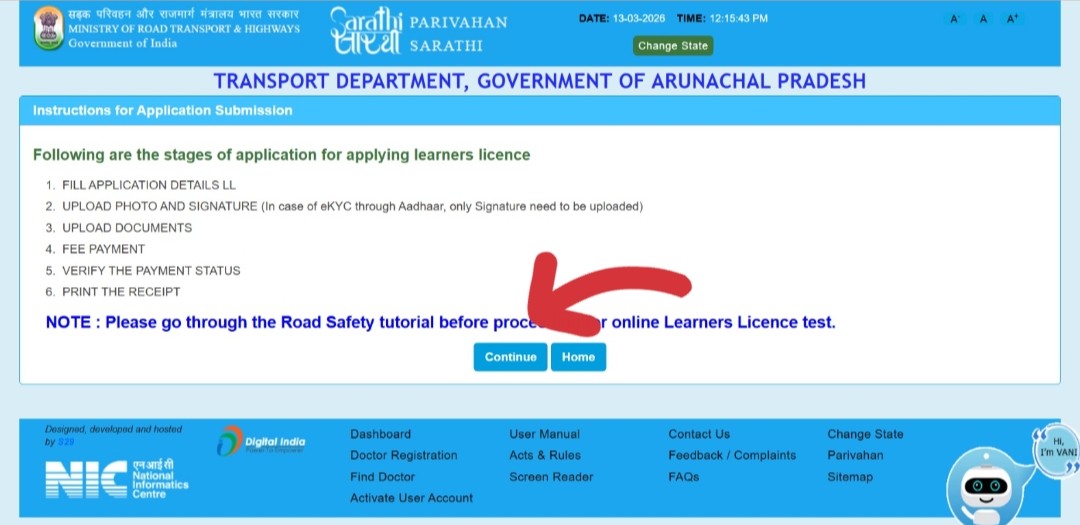 Submit the application and download the acknowledgement receipt
 -
8The RTO will review your application and schedule a physical inspection of your premises. You will receive an SMS or email with the inspection date. Ensure all facilities, vehicles, and instructors are present on the inspection day.
Apply Offline at the RTO
If online application is not yet available in your state or you prefer the offline route, visit the RTO where the driving school will operate.
-
1Visit the Regional Transport Office (RTO) under whose jurisdiction your driving school's premises fall. Collect Form 11 from the counter or download it from the Sarathi portal.
-
2Fill in Form 11 with complete and accurate details. Attach all required documents (see Section 7). Ensure all documents are self-attested.
-
3Submit the completed Form 11 application package at the Driving Licence / Driving School desk at the RTO. Pay the application fee at the RTO counter. Collect the acknowledgement receipt.
-
4The RTO schedules an inspection of your premises. Attend the inspection date with all facilities operational and instructors and vehicles present.
-
5After a successful inspection, the licence in Form 11 is issued. Collect it from the RTO or it may be dispatched by post depending on state practice.
RTO Inspection Process — What to Expect
The physical inspection is the most important step. An RTO officer (typically a Motor Vehicle Inspector or Regional Transport Officer) visits your premises and evaluates everything before the licence is granted. This is the point where most applications succeed or fail.
What the Inspector Checks
- Premises verification — confirms the address, measures the practice area, verifies the lease/ownership documents against the actual property
- Practice track/area — checks whether the track meets minimum size requirements, has proper markings, and is suitable for the training type applied for
- Classroom — verifies size, seating, lighting, ventilation, and the presence of required display materials (traffic signs charts, road rules posters)
- Training vehicles — inspects all vehicles physically: checks RC, insurance, PUC, fitness, dual control installation, and vehicle condition
- Instructor verification — verifies instructors are present, checks their DL documents, and may conduct a brief oral/practical assessment of instructor knowledge
- Records systems — checks that a student register, vehicle maintenance log, and other mandatory records are set up and ready to be maintained
- Safety provisions — fire extinguisher, first aid kit, and basic safety equipment
Prescribed Training Curriculum — What Must Be Taught
Under Section 12(6) of the Motor Vehicles Act (as amended in 2019), the central government prescribes the curriculum for driving schools. A licensed school must teach all prescribed modules. The curriculum broadly covers:
| Module | Topics Covered | Hours (Approx.) |
|---|---|---|
| Traffic Education I | Driving regulations, hand signals (driver + traffic police), traffic signs (mandatory, cautionary, informatory), road markings, automatic light signals, speed regulations, parking rules, relevant MVA provisions | 4–6 hours |
| Traffic Education II | Road safety, accident prevention, first aid basics, emergency procedures, effects of drugs and alcohol on driving | 2–4 hours |
| Vehicle Familiarisation | Identification of vehicle parts and their functions, pre-driving checks (before and after sitting), instrument panel explanation, fuel and oil levels, tyre condition | 2–3 hours |
| Basic Driving Practice | Starting and stopping, steering (push-and-pull method), reverse driving, hill start (gradient practice), gear changing (for geared vehicles), use of indicators and mirrors | 6–10 hours |
| Advanced Manoeuvres | 8-figure course (two-wheelers), parallel parking, three-point turn, reversing into a bay, overtaking, lane discipline | 4–6 hours |
| On-Road Driving | Supervised driving on public roads (once student has basic control), junction navigation, roundabouts, highway driving (where applicable) | 8–12 hours |
Fees for Driving School Licence
Fees are set by each state government and vary significantly. The following are approximate indicative fees — always confirm with your state RTO before applying.
| Fee Component | Approximate Amount | Notes |
|---|---|---|
| Application processing fee | ₹1,000 – ₹5,000 | Non-refundable; paid at application stage |
| Driving school licence fee (initial) | ₹5,000 – ₹25,000 | Varies by vehicle category and state |
| Inspection fee | ₹500 – ₹2,000 | Charged separately in some states for RTO inspection |
| Annual renewal fee | ₹2,000 – ₹10,000 | Paid at each annual renewal |
| Driving certificate fee (per student) | ₹50 – ₹200 | Fee for issuing the driving certificate to students |
Renewal and Ongoing Compliance
Licence Renewal
Driving school licences are typically valid for 1 year and must be renewed annually. Renewal requires:
- Applying on the Sarathi portal (or offline at the RTO) before the expiry date
- Submitting updated documents — current insurance and PUC for all vehicles, updated instructor details
- Paying the annual renewal fee
- Possible re-inspection by the RTO (especially if there have been complaints or significant changes)
Operating with an expired licence is an offence. If your licence lapses, you must apply for a fresh licence (not just renewal) and go through the full inspection process again.
Ongoing Compliance Obligations
- Student register: Maintain a complete and accurate register of all students enrolled, their training dates, vehicle used, and instructor assigned
- Vehicle maintenance log: Record all servicing, inspections, and repairs for every training vehicle
- Instructor attendance register: Maintain daily attendance of instructors
- Training completion records: Keep records of all driving certificates issued with student details
- Report to RTO: Submit periodic returns as required by your state (some states require monthly or quarterly submissions)
- Keep all vehicle documents current: Insurance, PUC, and fitness certificates for all training vehicles must never lapse
- Update Sarathi portal: Any change in instructors, vehicles, or address must be reported to the RTO and updated on the Sarathi system
Frequently Asked Questions
Generally no — most states require either ownership of the premises or a registered long-term lease agreement (minimum 10–15 years). A short-term rental or unregistered agreement is typically not accepted because driving schools need to demonstrate stability and continuity. Some states may accept shorter lease periods for renewals but require longer tenures for fresh licences. Verify with your specific RTO.
The timeline depends on the RTO's workload and inspection schedule. Typically: application review takes 7–15 working days; inspection is scheduled within 30–60 days of application; if inspection is successful, the licence is issued within 7–14 days of the inspection. The total process commonly takes 2–3 months from application to licence. Delays often occur due to incomplete documents — ensure everything is in order before applying.
No. Operating a driving school and charging students for lessons without a valid Form 11 licence is illegal under Rule 24 of CMVR 1989. Any driving certificates issued by an unlicensed school are invalid and will not be accepted by RTOs for transport vehicle licence applications. Wait until your licence is issued before enrolling paying students.
No — a driving school certificate is not mandatory for applicants seeking a regular private vehicle DL (LMV or MCWG for personal use). The certificate is mandatory only for applicants seeking a transport vehicle licence (to drive buses, trucks, or other commercial vehicles as a profession). Regular DL applicants can take the driving test directly at the RTO without attending a driving school.
No — each premises (branch location) requires a separate driving school licence from the RTO having jurisdiction over that premises. If you plan to operate driving schools at two different addresses, you must apply for two separate licences and undergo two separate inspections. Some states may allow a group or chain of driving schools under a registered company, but each branch still requires its own Form 11 licence.
An instructor whose DL has expired or is suspended is no longer qualified to teach. They must immediately stop providing instruction. You must inform the RTO and either replace the instructor or suspend their teaching until the DL is renewed. Continuing to employ an instructor with an expired or suspended DL is a compliance violation that can result in your school's licence being suspended.
Only for the categories specified on your Form 11 licence. If your licence covers LMV training, you can only issue LMV driving certificates. To add a new category (e.g., heavy vehicles), you must apply to the RTO to amend the licence — this typically requires an additional inspection to verify you have the appropriate vehicles, track space, and qualified instructors for the new category.
There is no fixed national minimum — however, the RTO may consider whether a school is genuinely operational when reviewing renewal applications. Schools with very few students or inconsistent records may face additional scrutiny during renewal inspections. Maintaining complete, accurate records and regularly submitting required returns to the RTO demonstrates genuine operation.