📜 In This Article
- What is a National Permit (All India Permit)?
- Types of Commercial Vehicle Permits
- Who Needs a National Permit?
- Eligibility Conditions
- Documents Required
- Form 46 and Form 48 — Explained
- How to Apply — Step by Step
- Pay Composite Fee Online (Parivahan Portal)
- National Permit Fee Structure 2026
- State-Wise Composite Tax
- National Permit Validity
- How to Renew a National Permit
- Check National Permit Status Online
- Penalties for Operating Without a Permit
- Frequently Asked Questions
What is a National Permit (All India Permit)?
A National Permit — officially called the All India Permit and often referred to as the National Goods Carriage Permit — is a special authorisation granted by a state's Regional Transport Authority (RTA) that allows a commercial goods carriage vehicle to legally operate beyond its home state.
Under the Motor Vehicles Act, 1988, goods vehicles must carry a permit to operate commercially. While a regular goods carriage permit only allows operation within the home state, a National Permit extends this right to cover multiple states — either a minimum of four contiguous states (including the home state) or the entire territory of India.
Why a National Permit Matters
- Without it, a goods vehicle registered in one state cannot legally carry goods into another state
- It eliminates the need to get individual state permits or counter-signatures from every state the vehicle passes through
- A single National Permit with payment of composite tax replaces the previously cumbersome state-by-state permit system
- Transport authorities and check-post officers verify the permit at state borders — an expired or absent permit can lead to vehicle detention and heavy fines
- Mandatory for all freight logistics companies, fleet operators, and independent truckers doing interstate business
Types of Commercial Vehicle Permits in India
Understanding where National Permit fits within the broader permit system helps you choose the right permit for your operation.
National Permit (All India Permit)
Allows a goods carriage vehicle to operate across a minimum of 4 contiguous states (including home state) or all of India. Composite tax paid to avoid state-by-state permits. This guide covers this permit in full.
Goods Carriage Permit (State)
Allows commercial transportation of goods within a single state only. Issued by the home state's RTA. Cannot be used to carry goods into another state without a counter-signature or national permit.
All India Tourist Permit (AITP)
For tourist/passenger vehicles (taxis, buses) to operate across all states. Issued under Section 88(9) of MVA 1988 for a minimum of 3 contiguous states. Does not cover goods carriage.
Counter-Signature Permit
An endorsement on an existing goods permit by another state's RTA, allowing entry into that specific state. An alternative to National Permit for vehicles only needing access to 1–3 additional states.
Who Needs a National Permit?
A National Permit is required for any goods carriage vehicle that needs to carry goods across state boundaries into 3 or more additional states (4+ states total). Common examples:
- Long-haul truckers carrying goods on national highways across multiple states (e.g., Delhi–Mumbai, Chennai–Kolkata routes)
- Logistics and freight companies with inter-state delivery operations
- Fleet operators running trucks, lorries, or heavy goods vehicles on all-India routes
- E-commerce logistics vehicles carrying packages across state borders
- Tankers transporting petroleum products, chemicals, or liquids across states
- Refrigerated vehicles carrying perishable goods (dairy, produce) on inter-state routes
- Multi-axle vehicles and container trucks on pan-India routes
Who Does NOT Need a National Permit
- Goods vehicles operating only within the home state — a regular goods carriage permit suffices
- Private vehicles (even if carrying goods occasionally for personal use)
- Passenger vehicles — they need the All India Tourist Permit (different permit)
- Vehicles carrying goods across only 1–2 additional states — counter-signature may be more suitable
Eligibility Conditions for a National Permit
A vehicle must satisfy all of the following conditions to be eligible for a National Permit:
- Must be a goods carriage vehicle — trucks, lorries, tankers, refrigerated vehicles, flatbed carriers, container vehicles etc. Passenger vehicles are not eligible for national goods permit.
- Vehicle age not more than 12 years — for standard goods vehicles (LGV, HGV). For multi-axle vehicles, the maximum age is extended to 15 years.
- Valid Fitness Certificate (FC) — a current, unexpired fitness certificate issued by the RTO is mandatory. Without it, no permit application is accepted.
- Valid insurance certificate — the vehicle must have a valid commercial vehicle insurance policy. Third-party liability insurance is the minimum legal requirement.
- Valid PUC certificate — a current Pollution Under Control certificate is required at the time of application.
- Valid RC (Registration Certificate) — the vehicle must be properly registered as a commercial goods vehicle with a yellow number plate.
- Current road tax payment — proof that the home state's road tax has been paid for the current quarter.
- Minimum 4 contiguous states — the national permit must cover at least 4 contiguous states including the home state. You cannot get a national permit for only 2 or 3 states — that requires counter-signature permits instead.
- No disqualification of the owner/operator — the permit applicant must not have had a permit cancelled or suspended for a serious violation in the recent past.
Documents Required for National Permit Application
- Form 46 — Application for grant of authorisation for national permit (to be submitted along with Form 48)
- Form 48 — Application for the grant of national permit (the main application form for the permit itself)
- Original RC (Registration Certificate) of the vehicle — must show commercial registration as goods carriage
- Valid Fitness Certificate — current, unexpired; issued by RTO after vehicle inspection
- Valid Insurance Certificate — comprehensive or at minimum third-party commercial vehicle policy
- Valid PUC Certificate — current pollution under control certificate
- Road tax payment receipt — current quarter's road tax paid to the home state; up-to-date tax receipts
- Demand drafts / bank drafts — drawn in favour of the Transport Authorities of each state selected in the permit, towards composite tax payment. One DD per state is required. Check current composite tax rates for each state before preparing DDs.
- National Permit authorisation fee payment receipt — proof of ₹1,000 per annum bank draft / online payment (Form 46 fee)
- Green tax payment receipt — if applicable (vehicles older than 8 years / 15 years must pay green tax at fitness renewal)
- Identity proof of owner/operator — Aadhaar Card, PAN Card, or Passport
- Address proof of owner/operator
- Existing permit copy — if applying for renewal, the original or expired permit must be submitted
- Company registration documents — for fleet operators / companies: GST certificate, incorporation certificate, or partnership deed
Form 46 and Form 48 — What They Are and What to Fill
Form 46 — Authorisation Application
Form 46 is the application for grant of authorisation for a National Permit. Under Section 87 of the MVA, Form 46 must be accompanied by a fee of ₹1,000 per annum in the form of a bank draft payable to the licensing authority. This form covers:
- Details of the vehicle (registration number, type, make, model)
- Name and address of the applicant/permit holder
- States for which authorisation is requested
- Confirmation of fee payment
Form 48 — National Permit Application
Form 48 is the main application for the grant of national permit itself. It contains the following fields:
- Full details of the vehicle (registration number, engine number, chassis number, gross vehicle weight, type of goods carriage)
- Details of the owner/operator (name, address, contact number)
- List of states where the permit is to be operative (minimum 4 contiguous states including home state, or all of India)
- Declaration that the composite tax has been paid or the demand drafts are enclosed
- Details of the existing goods permit of the vehicle (regular state permit)
- Date and signature of the applicant
How to Apply for a National Permit — Step by Step
The national permit application is primarily an offline process at the home state's RTA, but the composite fee payment can be done online through the Parivahan portal. Here is the complete process:
-
1Decide your operating states. Determine which states you need the permit to cover. The minimum is 4 contiguous states including your home state. To operate all-India (all 28 states + 8 UTs), select the "throughout India" option. The more states you include, the higher the composite tax.
-
2Pay the composite fee. Before submitting the forms, you must pay the composite fee — either online through the Parivahan National Permit portal (vahan.parivahan.gov.in/npermit/) or via demand drafts in favour of each selected state's transport authority. The consolidated all-India composite fee is ₹16,500 per annum. Payment receipt/DDs must be attached to Form 48. See Section 8 for online payment steps.
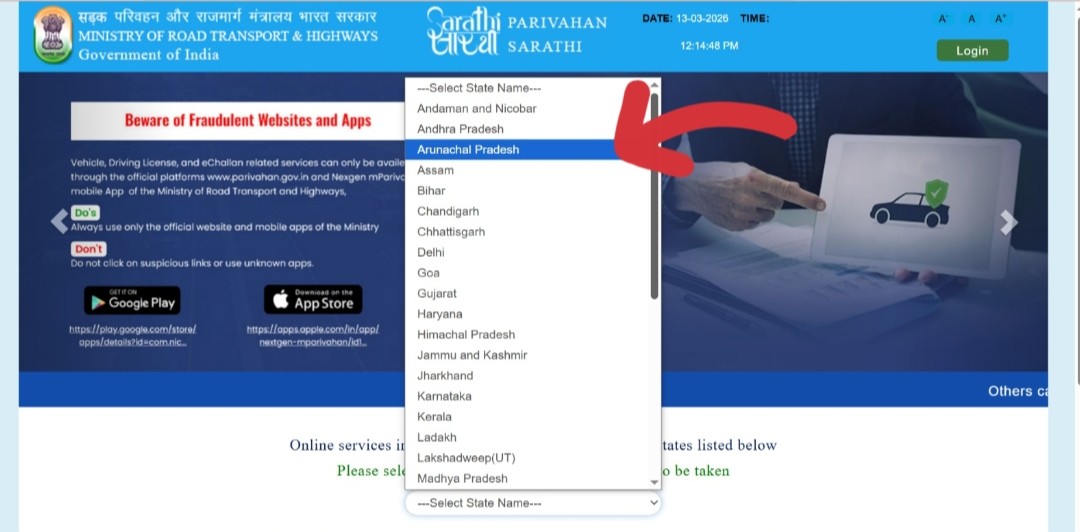 Pay the composite fee at vahan.parivahan.gov.in/npermit/ before submitting forms
 -
3Fill Form 46 and Form 48. Download both forms from parivahan.gov.in. Fill them completely and accurately. Ensure the states listed in both forms match the states for which you paid composite tax. The applicant must sign both forms.
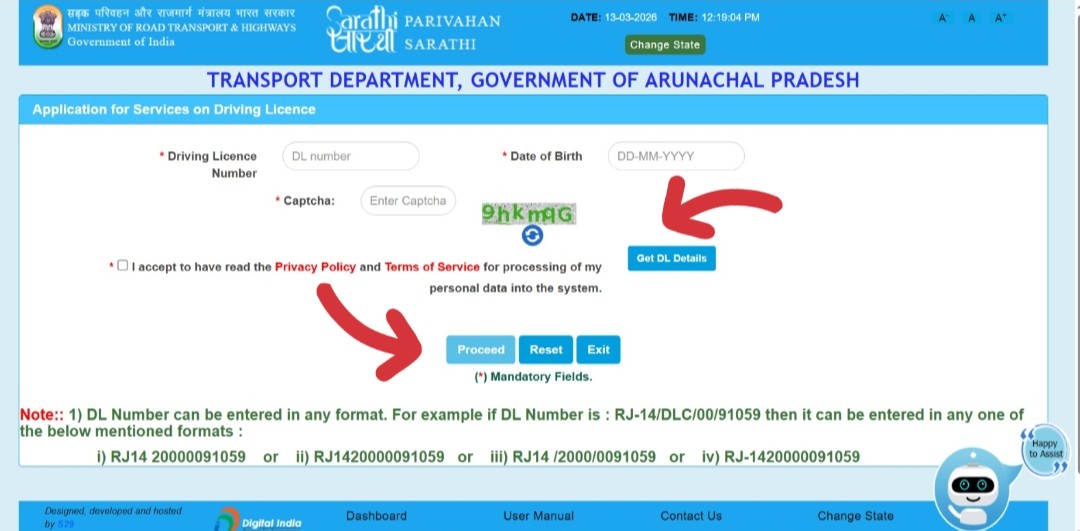 Fill Form 46 and Form 48 with complete vehicle and operator details
 -
4Compile the full document package. Assemble all required documents (see Section 5) — RC, Fitness Certificate, Insurance, PUC, road tax receipt, green tax receipt (if applicable), identity proof, and the composite fee payment proof (receipt or DDs).
-
5Submit at your home state's Regional Transport Authority (RTA). Visit the RTA (not just the local RTO — national permits are typically handled at the State/Regional Transport Authority level). Submit Forms 46 and 48 along with all documents. Pay the Form 46 authorisation fee of ₹1,000 per annum (if not already paid online).
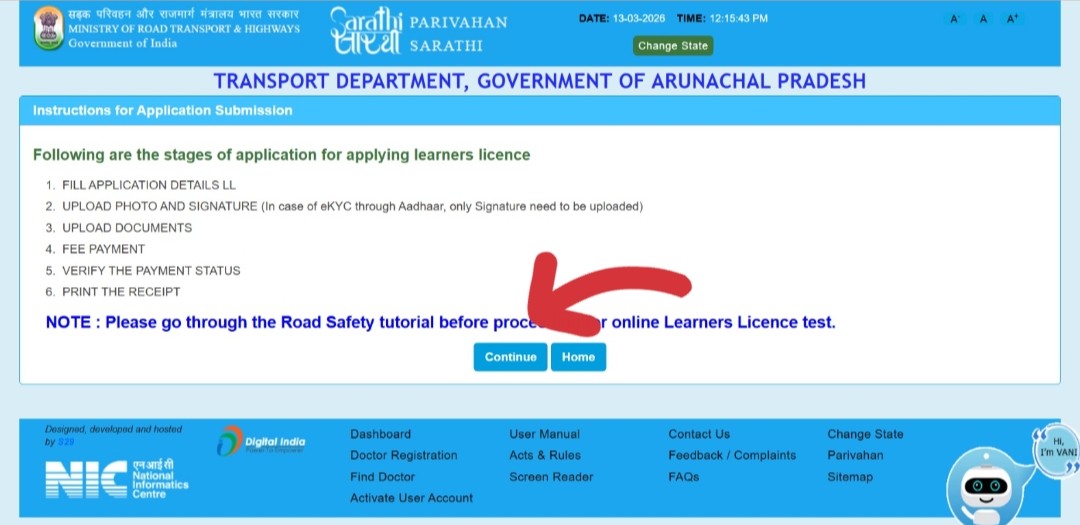 Submit both forms and all documents at your home state's Regional Transport Authority
 -
6RTA processes and uploads data. The transport authority reviews your application, verifies documents, and if everything is in order, uploads your vehicle's national permit data to the Parivahan (Vahan) national permit portal. Only transport authorities have access to upload — transporters cannot upload data themselves.
-
7National Permit issued in Form 47. Upon successful processing, the national permit is issued to you in Form 47 (if the RC is on a smart card) or in the designated paper format. The permit record also appears on the Vahan database, verifiable by traffic authorities at check posts.
Pay National Permit Composite Fee Online — Parivahan Portal
The Parivahan portal allows you to pay the national permit composite fee online — eliminating the need for demand drafts in many states. This is the preferred and faster method.
-
1Go to vahan.parivahan.gov.in/npermit/ — the dedicated National Permit online payment portal.
-
2Enter your vehicle registration number and the last 5 digits of the chassis number. Click Proceed.
-
3The portal displays your vehicle details. Verify the information is correct. Select the states you want the permit to cover from the list.
-
4The system calculates the total composite fee based on selected states. For all-India coverage, the consolidated fee is approximately ₹16,500 per annum (₹15,000 composite tax + fees). Review the amount.
-
5Complete payment via credit card, debit card, or net banking. After successful payment, download the payment receipt immediately.
-
6Print the payment receipt and attach it to your Form 48 application when submitting at the RTA. The receipt confirms the composite fee has been deposited to the National Permit account.
National Permit Fee Structure 2026
National Permit fees have two components: the authorisation fee (Form 46 fee) paid once per annum, and the composite tax paid for each state covered by the permit. Together, they form the total permit cost.
| Fee Component | Amount | Notes |
|---|---|---|
| Form 46 Authorisation Fee | ₹1,000 per annum | Bank draft in favour of licensing authority. Section 87 CMVR prescribed fee. |
| Consolidated All-India Composite Fee | ₹16,500 per annum | Covers all 28 states + 8 UTs. Deposited in national permit account via Parivahan portal. |
| Selected States Only (per state) | Varies by state | If not opting for all-India, pay composite tax only for selected states. Minimum 4 states. |
| Late Renewal Fee | ₹20 per day | Applied after permit expiry date until renewal payment is made. |
| Duplicate Permit Fee | 50% of original fee | For replacement of lost or damaged permit. |
| Green Tax | 10–50% of road tax | Applicable for vehicles older than 8 years (commercial) at fitness renewal. Varies by vehicle age and state. |
State-Wise Composite Tax for National Permit
If you are opting to include specific states rather than all-India coverage, composite tax must be paid for each selected state individually. The amounts below are indicative — verify current rates with your RTA or on the Parivahan portal before preparing payment.
| State | Approximate Composite Tax (per annum) | Notes |
|---|---|---|
| Andhra Pradesh | ₹1,200 – ₹1,500 | Rate may vary by vehicle category |
| Bihar | ₹800 – ₹1,200 | |
| Delhi | ₹1,500 – ₹2,000 | Entry restrictions apply for heavy diesel vehicles |
| Gujarat | ₹1,000 – ₹1,500 | |
| Haryana | ₹1,000 – ₹1,500 | |
| Karnataka | ₹1,500 – ₹2,000 | |
| Kerala | ₹1,200 – ₹1,800 | |
| Madhya Pradesh | ₹1,000 – ₹1,500 | |
| Maharashtra | ₹1,500 – ₹2,000 | |
| Punjab | ₹1,000 – ₹1,500 | |
| Rajasthan | ₹1,000 – ₹1,500 | |
| Tamil Nadu | ₹1,200 – ₹1,800 | |
| Telangana | ₹1,200 – ₹1,500 | |
| Uttar Pradesh | ₹1,000 – ₹1,500 |
National Permit Validity
National Permit validity follows a specific structure that is important to understand:
Special Validity Cases
- Vehicle replacement: If you replace the vehicle covered under a national permit with another vehicle of the same category, you have 4 months to get prior permission from the issuing authority and transfer the permit to the replacement vehicle.
- Temporary permit: A temporary national permit may be issued for a single journey under Section 87 of MVA. Validity does not exceed one trip or the period specified by the authority.
How to Renew a National Permit
A national permit must be renewed within the prescribed time to avoid a lapse in authorisation. Late renewal attracts a penalty of ₹20 per day from the expiry date.
Annual Composite Fee Renewal (Every Year)
-
1At least 15 days before the composite fee due date, log on to vahan.parivahan.gov.in/npermit/ and make the online composite fee payment for the next annual period. Save the receipt.
-
2Submit the payment receipt to the RTA (or update on the Vahan portal) to confirm the authorisation renewal. The transport authority updates the Vahan database.
Full Permit Renewal (Every 5 Years)
-
1At least 15 days before the permit expiry date, submit a Permit Renewal Application (PRA) at your home state's RTA.
-
2Attach the expired or about-to-expire permit, current vehicle documents (RC, Fitness Certificate, Insurance, PUC), up-to-date road tax receipts, and current composite fee payment receipt.
-
3Pay the renewal fee — same as the initial permit fee. The renewed permit is valid for a further 5 years from the renewal date.
Check National Permit Status Online
You can verify your vehicle's national permit status, check whether the composite fee has been correctly recorded, and download the permit online through the Parivahan portal.
Method 1 — Parivahan National Permit Portal
-
1Go to vahan.parivahan.gov.in/npermit/ and enter your vehicle registration number and the last 5 characters of chassis number.
-
2The portal shows your national permit status — active or expired, states covered, valid until date, and payment history.
Method 2 — Vahan Know Your Vehicle
-
1Go to vahan.parivahan.gov.in → Informational Services → Know Your Vehicle Details.
-
2Enter the vehicle registration number and login. The vehicle details page shows the permit status, permit validity, and fitness certificate validity alongside RC, insurance, and tax status.
Method 3 — SMS
Send VAHAN [registration number] to 7738299899. The reply includes permit validity along with other vehicle details.
Penalties for Operating Without a Valid Permit
Operating Without a Permit — Section 192A MVA
Under Section 192A of the Motor Vehicles Act, operating a goods vehicle without a valid permit or in violation of permit conditions can result in a fine of up to ₹10,000 for a first offence and up to ₹25,000 for subsequent offences. The vehicle may also be impounded by the enforcement authorities until the permit situation is regularised.
| Violation | Action / Penalty |
|---|---|
| No permit at all | Fine ₹10,000 (first offence), ₹25,000 (repeat); vehicle detained at check post |
| Expired permit | Fine + detention; must regularise permit before vehicle released |
| Permit for fewer states than route covered | Fine + vehicle detained at the state border check post |
| Annual composite fee not paid | Late fee ₹20/day + the permit is treated as lapsed; same as no permit at border check posts |
| Permit conditions violated | RTA action under Section 86 MVA — permit may be suspended or cancelled |
| Operating in Delhi (heavy diesel, GVW > 7,500 kg) | Prohibited entry, vehicle detained; specific Delhi transport rules apply |
Frequently Asked Questions
Not entirely. While the composite fee payment can be made online through the Parivahan portal (vahan.parivahan.gov.in/npermit/), the physical application with Form 46 and Form 48 and supporting documents must still be submitted at the home state's Regional Transport Authority. The full online application process for national permits is not yet available on the Parivahan portal. MoRTH is working toward greater digitisation, but as of 2026, an RTA visit is still required for the initial application and full renewal.
They must be contiguous (geographically connected) and must include the home state. A national permit covering disconnected or non-adjacent states is not valid under the CMVR definition. For example, if your vehicle is registered in Maharashtra, you could get a permit for Maharashtra + Karnataka + Telangana + Andhra Pradesh (contiguous) but not Maharashtra + Delhi + West Bengal (non-contiguous) without all-India coverage. If your routes are not contiguous, opt for all-India coverage.
Yes. A Delhi–Mumbai run crosses at least three states (Maharashtra, Gujarat or MP, Rajasthan, and Delhi — 4 states minimum). You need a National Permit covering at least those 4 states. If your route varies, all-India coverage is the most flexible and practical option for long-haul truckers.
National Permits are vehicle-specific and non-transferable to another owner. When you sell the vehicle, the permit does not automatically transfer to the new owner. The new owner must apply for a fresh permit. The old permit becomes void on ownership transfer. If you sell the vehicle, withdraw the permit application and notify the RTA to avoid any liability for the vehicle's operation after transfer.
A Goods Carriage Permit (state permit) allows commercial goods transportation only within the home state. A National Permit extends this to 4 or more contiguous states or all of India, with composite tax replacing state-by-state fees. All national permit vehicles must also have a valid underlying state goods permit — the national permit is an additional authorisation on top of the state permit, not a replacement for it.
No for standard goods vehicles — the maximum vehicle age for national permit eligibility is 12 years. For multi-axle vehicles specifically, the age limit is 15 years. If your standard truck is older than 12 years, it is no longer eligible for a national permit or its renewal. The vehicle would need to operate with state permits and counter-signatures only within more limited routes.
The permit itself is not immediately cancelled — but the authorisation to operate in other states effectively lapses. At border check posts, an outdated or unrenewed composite fee makes the vehicle effectively without valid interstate authorisation. A late fee of ₹20 per day applies from the expiry date. Pay the annual composite fee before the due date to maintain continuous, uninterrupted interstate authorisation.
No. National Permits under Section 88(12) are only for commercial goods carriage vehicles — trucks, lorries, tankers, and similar freight vehicles registered as goods carriages (yellow number plate). Private vehicles (white plates) are not eligible. If a private vehicle is used to carry goods commercially, it must first be converted to commercial registration, pay relevant taxes, and then apply for the appropriate permit.